
Blogs
China IP Law Update
China’s Ministry of Commerce Releases Draft Provisions Targeting Foreign Entities Over Trade Secret Infringement
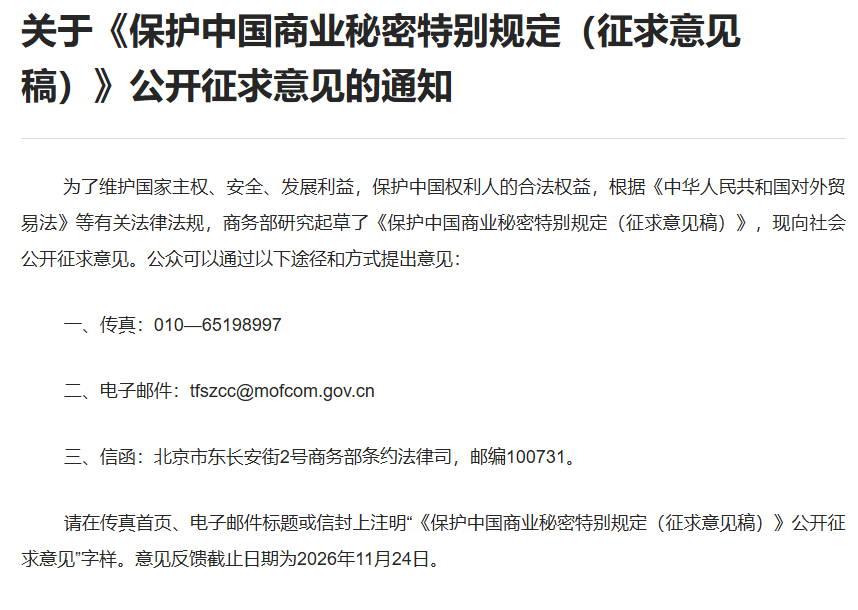
On October 26, 2026, China’s Ministry of Commerce (MOFCOM) released the Special Provisions on Protecting China’s Trade Secrets (Draft for Comment) (保护中国商业秘密特别规定(征求意见稿)). Despite its title, the Draft does not address general trade secret protection. It is a sanctions-style mechanism aimed at foreign companies, organizations, and individuals: where MOFCOM determines that a foreign entity’s infringement of a Chinese trade secret endangers, or poses an actual threat to, China’s national sovereignty, security, or development interests, MOFCOM may impose trade, investment, entry, residency, and monetary penalties on that entity, following an investigation in which the foreign entity has only limited procedural protections. The draft adds a trade secret-specific tool to the set of instruments MOFCOM has built since 2025 for restricting or retaliating against foreign entities in trade disputes.
MOFCOM has added several instruments in 2025 and 2026 that apply to foreign entities in trade disputes. Following State Council Decree 834, MOFCOM issued the Measures for Industrial and Supply Chain Security Investigations on June 22, 2026, authorizing investigations and countermeasures against foreign states, organizations, or individuals whose conduct is deemed a threat to China’s supply chains.
Further, in October 2026, China moved to tighten its export control architecture through distinct but overlapping regulatory tracks targeting critical technologies and dual-use materials. First, On October 16, 2026, the Ministry of Commerce (MOFCOM) and the Ministry of Science and Technology (MOST) jointly issued Announcement No. 48, a unified regulatory proposal that introduced draft amendments to add 40 technology fields – including 23 in artificial intelligence (such as core large-scale models), 12 in photovoltaics, and 5 in biopharmaceuticals – to the Catalogue of Technologies Prohibited or Restricted from Export (中国禁止出口限制出口技术目录). While these substantive catalogue revisions remain subject to a public comment period ending November 15, 2026, Announcement No. 48 immediately enacted temporary pre-export registration requirements for all 40 designated fields effective October 16.
Operating on a separate legal track, MOFCOM is simultaneously poised to enforce separate, previously enacted export licensing rules and dual-use item controls covering rare earth elements, ultra-hard synthetic materials, and magnet manufacturing technologies, which are reported to take effect or see expanded enforcement deadlines in November 2026.
A translation of the Draft Provisions follows. Comments are due November 24, 2026. The original announcement is available here (Chinese only).
Article 1 [Legislative Purpose]
These Provisions are formulated in accordance with the Foreign Trade Law of the People’s Republic of China, the Anti-Unfair Competition Law of the People’s Republic of China, and other relevant laws and regulations. Their purpose is to safeguard national sovereignty, security, and development interests and to protect the legitimate rights and interests of rights holders.
Article 2 [Scope of Application]
These Provisions apply where a foreign entity, in international economic and trade activities and related activities, commits relevant acts infringing Chinese trade secrets, and the conduct also either endangers China’s national sovereignty, security, or development interests, or poses an actual threat to those interests.
Article 3 [Basic Definitions]
“Foreign entity” as used in these Provisions includes foreign enterprises, other organizations, or individuals. “Rights holder” as used in these Provisions means the owner of a trade secret and any user of the trade secret licensed by the owner.
Article 4 [Division of Responsibilities]
MOFCOM is responsible for organizing the implementation of these Provisions and shall carry out related work together with relevant departments according to their respective duties and authority, strengthening coordination, cooperation, information sharing, and notification. MOFCOM, relevant departments, and their staff shall keep confidential, in accordance with law, state secrets, trade secrets, and other information learned in the course of their work.
Article 5 [Measures]
Where a foreign entity commits the conduct specified in Article 2, MOFCOM may decide to take one or more measures against it, including restricting or prohibiting its import and export of goods and technology and its international trade in services related to China, prohibiting the export of relevant items to it, restricting or prohibiting its new investment within China, restricting or prohibiting the entry of its relevant personnel or means of transport, restricting or revoking the work permits and stay or residence qualifications of its relevant personnel within China, imposing a fine of a corresponding amount in accordance with law based on the severity of the circumstances, and other necessary measures. MOFCOM, together with relevant departments, shall implement these measures in accordance with law and according to their respective duties and authority, and relevant enterprises, other organizations, and individuals shall cooperate.
Article 6 [Investigation and Reporting]
Where a foreign entity commits the relevant acts in Article 2, MOFCOM has the authority to decide whether to investigate whether the conduct endangers China’s national sovereignty, security, or development interests. Where MOFCOM decides to investigate, the foreign entity shall cooperate, accept inquiries, truthfully report the relevant circumstances, and provide relevant materials, and may make statements and present a defense. Where the foreign entity does not cooperate, or otherwise obstructs the investigation, MOFCOM may make a decision based on the facts already obtained. Enterprises, other organizations, or individuals may submit suggestions or reports to MOFCOM regarding matters related to infringement of trade secrets by foreign entities.
Article 7 [Modification and Cancellation]
A foreign entity subject to measures under Article 5 may apply to modify or cancel those measures if it voluntarily takes corrective action, stops the infringement, eliminates the danger, and compensates for losses, and the application shall state the facts and reasons concerning the corrective action and the elimination of the consequences of the conduct. MOFCOM may, on the foreign entity’s application or based on actual circumstances, organize an assessment of the implementation and effect of the measures under Article 5, and based on the results, decide to maintain, suspend, modify, or cancel the measures.
Article 8 [Public Announcement]
MOFCOM shall publicly announce decisions made under Articles 5, 6, and 7, except where laws or administrative regulations provide otherwise.
Article 9 [Application for Exemption]
Where a Chinese enterprise, other organization, or individual, under special circumstances, needs to transact with a foreign entity subject to measures under Article 5, it shall apply to MOFCOM and provide the facts and reasons, and with MOFCOM’s approval, may conduct the corresponding transaction with that foreign entity or provide the relevant items.
Article 10 [Effective Date]
These Provisions take effect on the date of promulgation.
[END]
Note that the Special Provisions on Protecting China’s Trade Secrets (Draft for Comment) has two triggers, and the second – conduct that poses an “actual threat” – covers situations where no harm has yet occurred, which gives MOFCOM a basis to act preemptively. Further, the term Chinese trade secrets is unclear – is it dependent on the holder’s nationality, the location of the trade secret, or some other connection, whether trade secrets held by foreign-invested enterprises in China are included, and whether conduct occurring entirely outside China is covered given the absence of a territorial limit.
The Draft does not specify time limits for investigations, hearing procedures, an evidentiary standard, or a notice requirement before measures are imposed. Article 5’s fine provision states no amount, calculation method, or cap.
Original article can be found here: Read more